Showing posts with label Profile. Show all posts

Friday, 21 November 2014

Dr Cecile Perrault is the latest Sheffield engineer on our Wall of Women!

 
Cecile's research combines biology, medicine and engineering. As a lecturer in the Department of Mechanical Engineering she studies the application of mechanical forces to replicate the effect on human cells of the range of environments in the human body. This knowledge can then be applied by industry in the production of pharmaceuticals.

Find out more about Cecile's work here.
  

Tuesday, 11 November 2014

Introducing your new Faculty Director for Women in Engineering…


Hello! I’m Rachael (with 2 a’s) Elder (not to be confused with Rachel (with 1 a) Horn, Faculty Director for Learning and Teaching) and I am your new Faculty Director for Women in Engineering. I took over from Elena as FDWiE in the summer and have spent the last couple of months reviewing where we’re at with our WiE activities. It’s exciting times as we have lots of fantastic activities going on in and around the faculty. I’m also excited to say that for the first time ever females outnumber males as Faculty Directors – Mike Hounslow, Pro-Vice-Chancellor for Engineering, is also excited about this, although he may be wishing there were fewer Rach(a)els to avoid confusion :). I will be writing a monthly blog post and thought I’d take the opportunity of the first one to introduce myself and tell you a bit about me and my plans for WiE at Sheffield.

Where it all started…

Rachael (centre) and her fellow Battlers at the Engineering Imagination
event held to celebrate Women in Engineering Day 2014.

I grew up in Teesside, spent most of my time running around the North York Moors and climbing trees. Between the other things I squeezed in Maths, Physics, Chemistry and Further Maths at A-Level then an MEng in Chemical Engineering at Cambridge. I made this choice due to the breadth of the first year in Natural Sciences which allowed me to continue with my A level subjects plus Materials Science. I loved the applied nature of Chemical Engineering and knew I wanted to work in Chemical Engineering after only a few weeks on the course. Before graduation I applied for lots of jobs in industry as a Chemical Engineer, was offered some, and turned them down. Instead I chose to spend a year living in Sweden working part-time as an orienteering teacher, learning Swedish and concentrating on my second passion – orienteering. I started orienteering as an 8 year old and my dad used to follow me round the forest to ensure I didn’t get lost. 9 years later I was a member of the British team and have since raced in 3 Junior World Champs, 5 World University Champs and 7 World Champs. I’ve collected a number of British titles, my proudest achievements are two World Students Relay Gold medals and a top 20 placing at the World Champs, however the most important things I’ve taken from my orienteering career are determination, dedication, and an ability to push myself to be the best. I’ve also gained an incredible number of friends all around the world. During my year in Sweden I realised I couldn’t just be an orienteer and decided to apply for a PhD as I’d really enjoyed my research in my MEng course. I chose Sheffield… 

Life in Academia… 

My PhD was on thermochemical hydrogen production. I spent a lot of time in the lab working with membranes as a separation technique, as well as process system modelling, and of course a lot of running, orienteering and other outdoor sports. I became Dr Elder in 2007 and then stayed in Sheffield working as a post doc. During this time I did a lot of teaching and started to think harder about a career in academia. About a year later someone suggested I should apply for a lectureship being advertised. I thought my chance of success was small but decided to go for it anyway - at least I'd find the holes in my CV! To my delight I was offered the job! The first three years as a probationary lecturer weren’t easy - juggling teaching, admin responsibilities, ongoing research, paper writing and trying to bring in grants with my orienteering career was a tough challenge. There were many times I questioned if I was doing the right thing, but having come through those years I can confidently say: Yes, I was! Two years ago I retired from international orienteering, last year I was promoted to senior lecturer and now I have taken on Women in Engineering…

Women in Engineering…

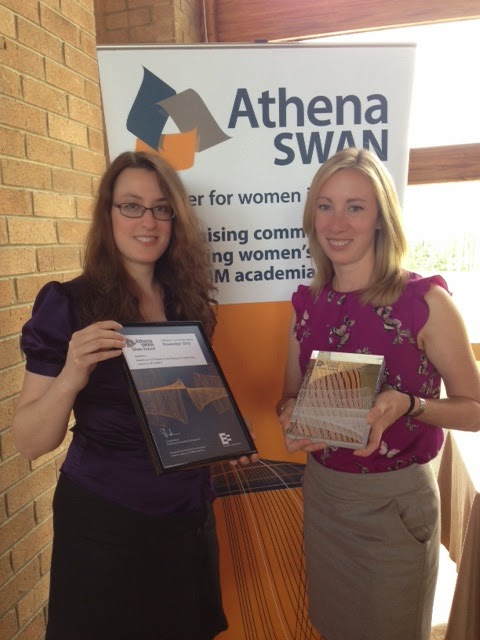
Ioanna Dimitriou and Rachael with the Certificate
and Trophy for the CBE Silver Athena SWAN Award.
Over the last few years I have become more involved in efforts to increase the number of women in engineering. I led CBE’s successful Athena SWAN Silver award submission and through this have been active in improving culture in the department. I’m looking forward to bringing my experience and skills to the faculty role. Four other departments in the faculty have bronze awards - It’s been exciting to see the changes that have gone on in the Faculty over the last few years, partly due to our Athena SWAN activities and partly due to increased awareness of some of the issues we face. We have made excellent progress, but still have some way to go. The primary goal is to make positive changes and improve working culture; not just getting awards, but making them count. It is great to see the efforts being made by all of the departments and very rewarding to see them recognised.

The remit of FDWiE includes equality and diversity, as well as gender – the most striking inequality in engineering. I have recently reviewed our structure and am pleased to say that we are introducing a Faculty Equality and Diversity Committee. I am recruiting members now and we hope to have the first meeting before the end of the year. 

Alongside my women in engineering activities, my research investigates carbon dioxide utilisation to form fuels and I am of course still running and orienteering, although there’s more coaching and less racing creeping in. To add another ball to my already full juggling arms, I am 20 weeks pregnant so embarking on yet more challenges and unknowns. :) But that’s the subject of a future blog post!

If you have any comment or would like to get in touch, please do! My email address is: r.elder@sheffield.ac.uk.

Rachael


Wednesday, 29 October 2014

#BustingStereotypes with Sebastiana.

On Tuesday 28th October the BBC ran a special day of events celebrating the achievements of inspirational women. You might have seen us joining in, by tweeting about our own University of Sheffield women who are #BustingStereotypes. Today we have a post about a young family who are also #BustingStereotypes in the way they've decided to divide up childcare - and what that means for their careers.

It's a well-known fact that studying for a PhD requires hard work, commitment, dedication and the drive to succeed. It's also a well-known fact that being a mother is difficult - sleepless nights, nappy changes and the challenges of parenting all take their toll. A lot has been written about the challenges of balancing an academic career and parenthood - but what about those who become parents while they're still studying?

Sebastiana, who studied Industrial Chemistry and Chemical Engineering undergraduate and masters degrees at the University of Catania (Sicily) before moving to Sheffield with her Italian husband earlier this year, is in the first year of her PhD in Synthetic Ecology - and also in her first year of bringing up a young daughter. We caught up with her in the Mappin Café to find out about the challenges of bringing up a family, overcoming stereotypes and why some of the same skills are needed in both engineering and parenting.

Sebastiana decided to become an engineer after being inspired by her husband and sisters, who both have engineering degrees. "In Italy, being an engineer is prestigious - it's a title, like 'Doctor', people might refer to you as Engineer. It means you have a good education and good skills. There is some dirty work, but fundamentally it's a top position." Having studied Chemistry, she realised that engineering has a more practical focus, working on solving real-world problems, and this is what attracted her. It wasn't an easy choice - in Italy only two out of twenty people studying her course were female, and she acknowledges that it was harder for her than others. "As a woman in science, I had to work to be better than everybody else - not only academically, but I had to work harder to prove myself, because I am a woman. Some of my professors had old-fashioned views about things."

Sebastiana was six months pregnant by the end of her Masters degree, and she knew she wanted to carry on with a PhD at Sheffield. Although her parents were extremely supportive of her career choices, that wasn't the case for everybody in her life. "In Sicily, where I come from, there is still this perception - why do you need to work? Your husband has a job! You're expected to stop working when you have a baby," she says. "But I was very clear with my husband from the start - this is what I want to do. He supports me in that."

So, in the last weeks of her pregnancy, she prepared and submitted her research proposal, choosing Sheffield because of its place in international university rankings and the research interests of her supervisor. Just one week after she gave birth to her daughter, she was interviewed - and offered a place. She and her family made the move to Sheffield earlier this year. Now, she spends her days in the lab, while her husband looks after their daughter. "I didn't want to put my career on hold because I had had a baby - I felt like I'd miss opportunities. My husband doesn't speak much English - when the baby is a little older he can go to English classes - so this was the best choice."

"In Sicily this would be really unusual. But studying for my PhD, that's my 'me time'!" she laughs.

How does she balance her responsibilities? "I come into work early, take just a 30 minute lunch break, and focus on what I have to do while I'm here. My husband looks after the baby in the day and when I'm home in the evening that's my time for my husband and my family - though I do sometimes work at the weekend, if the baby is asleep. The supervisor is important - PhD students can feel isolated because there's just you and the research. But my supervisor is really supportive. When I said I had a baby, he said "that's great!" He treats me just like he treats everybody else. In the future I want to move into a post-doctoral position and carry on researching."

Would Sebastiana encourage other women to follow a career in engineering? "I don't think we should distinguish between men and women," she says. "It should be about whether you have the skills and the capacity. But I think females can be better than males! Women don't fear challenges and problems and can deal with a lot of things - we are multi-taskers. You need all these skills as an engineer."

I ask how having a daughter has changed her. "I am more patient now. Things go wrong in parenting and you have to try to find solutions. The baby can't talk! But it's the same in the lab - things don't work as they should and you have to try to fix it. It's all research."

Would she want her daughter to be an engineer? "She might have different aspirations. Both her parents are engineers, so no pressure! I want her to know that she has options and can choose - she can be whatever she wants to be."


Finally, I ask Sebastiana whether having a baby and studying engineering means that she still has to be better than everybody else - do people doubt her commitment to her role? Does she still have to prove herself all the time? "I still work hard, but because I want to work hard and do well, because I want the University to be proud of me like I am of belonging to it...not because people doubt my value. But being both a mum and an engineer doesn't make me that unusual. When you are motivated and you have one true dream, you find inside you the strength to do what you want to do."

Tuesday, 21 October 2014

Sheffield academic nominated in the 2014 WISE Awards!

If you've been following us for a while, it will come as no surprise that the University of Sheffield's Faculty of Engineering has plenty of inspirational female role-models. So we're delighted that one of our own has been nominated in the 2014 WISE Awards! Professor Elena Rodriguez-Falcon, Professor of Enterprise and Engineering Education, Director of Enterprise Education in the University of Sheffield, Faculty Director of Communications and External Relations, and (last but certainly not least!) former Faculty Director for Women in Engineering, has been shortlisted for the 2014 WISE Champion Award.

WISE (or Women into Science, Engineering and Construction) works to inspire girls to choose science, technology, engineering and mathematics pathways and has the target of increasing the number of girls in the STEM workforce to 30% by 2020. The WISE Awards is an annual event which recognises and celebrates the achievements of individuals and organisations which are actively working towards WISE's goals. For her work in encouraging the recruitment, retention and progression of women in STEM subjects, Elena has been nominated as "an individual champion who has used their position to influence others to take positive action to promote female talent in STEM, within their own organisation or beyond." Elena was tasked with setting up the Women in Engineering project at Sheffield and led the initiative for three years.


The award ceremony will take place on Thursday 13 November at the Grange Hotel, Tower Bridge, London, and we'll keep you up to date with the winners. Congratulations, Elena!


Monday, 6 January 2014

Meet our students: Chandula Wickramarachchi, Aerospace Engineering student

Student Intern Phoebe Kimble-Wilde recently interviewed women students in the faculty to find out a bit about the women engineers at the University, why they chose engineering, what interests them and what they want to do in the future. Here she interviews Aerospace Engineering student Chandula Wickramarachchi.
"I have always liked maths and physics so engineering was a logical next step."

Monday, 2 December 2013

Meet our students: Adelina Balasa, Artificial Intelligence and Computer Science student

Student Intern Phoebe Kimble-Wilde interviewed women students in the faculty to find out a bit about the women engineers at the University, why they chose engineering, what interests them and what they want to do in the future. Here she interviews Computer Science student Adelina Balasa.


"I already have a job sorted for after graduation so I look forward to being an IT Consultant for one of the top companies in this field!"


Photo Credit:Mike.Turner via Compfight 
http://www.flickr.com/help/general/#147


Wednesday, 7 August 2013

Roma Agrawal - The Shard


Roma Agrawal 
(picture credited to 
 Nicola Evans, WSP group)

The Shard almost looks like an elaborate ice sculpture. Standing at 1,016ft high above London, this iconic building is now officially the tallest tower in Western Europe. From a layman’s point of view I wonder how on earth this was built and who would be brave enough to dangle over 300m off the ground to place the last pieces of glass. Comprising of five key areas: office space, restaurants, a hotel, apartments and The View at the top which is now open to the public, this piece of engineering and architecture is over a decade in the making. Angela Bairstow spoke to Ms Roma Agrawal, who currently works for WSP Group in London and was Senior Structural Engineer on The Shard, on what it was like to work on such a high profile project and that you don’t necessarily need an engineering degree to be an engineer.


Monday, 24 June 2013

Shruti Vasudev, student Bioengineer


BioEngineering student Shruti Vasudev was recently interviewed for the Times of India.  In the article she talks about her experiences at the University of Sheffield and placement at National Instruments.  You can view the Times of India article here: Raising the Bar.


Our own student media Intern, Phoebe Kimble-Wilde spoke to her about why she chose engineering, what interests her most and what she wants to do in the future. She also found out more about Shruti's hobbies and why she likes Sheffield.  

Monday, 22 April 2013

Staff profile: Wendy Birtwistle

Wendy Birtwistle is a technician in the Department of Mechanical Engineering and in this blog she talks about her career at the University, learning new skills and being a gadget lover with access to 3D printers and a flight simulator.