Tuesday, 17 February 2015

SELA success!


Today on the blog we hear from Bethany Jim, a second year undergraduate studying Materials Science and Engineering here at Sheffield. Bethany is one of four female students on the first cohort of the SELA programme and we asked her to describe how the experience had affected her.
Sheffield Engineering Leadership Academy (SELA) is an extra-curricular leadership programme launched by the University of Sheffield. I first heard of its existence and an opportunity to apply to the academy in the middle of my first year studying Materials Science and Engineering, and thought, ‘What’s the harm in applying?’ SELA appealed to me because I wanted a chance to develop my own skills and confidence as a leader to follow the path I want in engineering, especially as a female in the field.

After a concentrated effort with the challenging online application, I was invited to attend an interview and give a pitch to the SELA board. The thought of doing so made me extremely nervous, but I knew how much I wanted to seize the opportunity to better myself. Doing the interview and pitch alone gave me confidence in spades, so I was both surprised and excited to be offered a place on the first-ever cohort of SELA.

After a brief meeting with the other members at the beginning of the year, the first thing we were all required to do was attend a ‘leadership boot camp’. The title of the event had me imagining crazy scenarios. The only information we were given was a web link to the majestic-looking hotel we were to stay at in the Peak District, and a time and place to climb aboard the bus which would take us there. An air of mystery floated through the bus, and upon arrival at 9am, we were greeted by a glorious view complete with golf course. The SELA board members and our mentors for the weekend appeared in the doorway of the hotel shortly after and we were led to the luxurious suites where the boot camp was to begin.

The modules in which we participated over the two days included role play, which required a decision of whether or not to race a Formula 1 car; skyscraper building using spaghetti and marshmallows; and how to negotiate as business owners. We also learned new ways of thinking using different brightly coloured hats, what our working styles and drivers are, and how to effectively problem-solve in time-pressured situations. I found the modules were brilliant for understanding the importance of communication and learning how to differentiate between technical and business aspects. We worked in multi-disciplinary teams for the modules, ensuring healthy debate.  

On the Saturday evening, we relaxed and admired our bathrooms, wandered the grounds, and swam until the dinner bell. A delicious three-course meal was had by all and a ‘pitch club’ followed – we were told to pitch a product which would be useful for elderly people, and the winner would be awarded a beverage of their choice. After working hard at the modules the next day, our long-anticipated year’s project was revealed to us. We, as a cohort, now have the task to raise £10,000 to organise the following year’s boot camp in September 2015.

Now that I’m in my second year, I am focused on maintaining the best grades that I can, and as part of SELA, I receive mentoring, attend skills workshops, guest lectures and networking with leaders from industry and academia and will continue to do so alongside project work for my third year too, before I hope to complete a Masters in materials. One particularly memorable workshop I’ve had so far was on networking; I never knew how to approach people in networking events. After being thoroughly trained by a brilliant professional, I now finding the prospect of talking to people that I don’t know much less daunting, and I look forward to making connections with a wider circle.

To become a member of SELA, each cohort member is required to have a range of attributes, but I will never undervalue the simplest qualities of ambition and willingness to improve. I am one of only four girls selected for SELA this year, bearing in mind there are eighteen members in my cohort. I have tried not to let being a part of any ‘categories’ of people dissuade me from trying to achieve and I don’t believe anybody should let it dissuade them either. I want to grasp opportunities, generate new ideas and close the gender gap in STEM subjects as a young female engineer, whilst inspiring others to do the same. Since coming to university and winning a place in SELA, I have found the inner confidence to really go for the things which I want, and I hope it can be beneficial to my career in the future. It is impossible to avoid rejection completely, and in times where I have faced rejection, I have tried to learn from my mistakes and continue being brave. If I hadn’t mustered the confidence to grasp opportunities including SELA with both hands I don’t believe I would be typing this article.

Congratulations, Bethany - a brilliant message. We're hoping to hear more from Bethany about her fund-raising efforts this year and will keep you up to date on her success.

Monday, 8 December 2014

Wall of Women Update

We've something a little different on our Wall of Women today - an interview with Claire Johnson, who is a teaching technician. Claire now runs lab practicals for Bioengineering students, but studied biochemistry at Sheffield before getting a job at the Dental School and then moving into the Engineering faculty as a Research Technician in the Department of Materials Science and Engineering. Follow the link for Claire's interview.


Monday, 24 November 2014

Congratulations are in order!

Remember when we told you that our very own Elena Rodriguez-Falcon had been nominated for a 2014 WISE award? Well, we're delighted to say she was awarded Highly Commended in her category! Elena was recognised for having "used (her) position to influence others to take positive action to promote female talent in STEM, within their own organisation or beyond", and we'd certainly agree with that. Congratulations, Elena!


Elena, second from right, bottom row, with her award.

Friday, 21 November 2014

Dr Cecile Perrault is the latest Sheffield engineer on our Wall of Women!

 
Cecile's research combines biology, medicine and engineering. As a lecturer in the Department of Mechanical Engineering she studies the application of mechanical forces to replicate the effect on human cells of the range of environments in the human body. This knowledge can then be applied by industry in the production of pharmaceuticals.

Find out more about Cecile's work here.
  

Tuesday, 11 November 2014

Introducing your new Faculty Director for Women in Engineering…


Hello! I’m Rachael (with 2 a’s) Elder (not to be confused with Rachel (with 1 a) Horn, Faculty Director for Learning and Teaching) and I am your new Faculty Director for Women in Engineering. I took over from Elena as FDWiE in the summer and have spent the last couple of months reviewing where we’re at with our WiE activities. It’s exciting times as we have lots of fantastic activities going on in and around the faculty. I’m also excited to say that for the first time ever females outnumber males as Faculty Directors – Mike Hounslow, Pro-Vice-Chancellor for Engineering, is also excited about this, although he may be wishing there were fewer Rach(a)els to avoid confusion :). I will be writing a monthly blog post and thought I’d take the opportunity of the first one to introduce myself and tell you a bit about me and my plans for WiE at Sheffield.

Where it all started…

Rachael (centre) and her fellow Battlers at the Engineering Imagination
event held to celebrate Women in Engineering Day 2014.

I grew up in Teesside, spent most of my time running around the North York Moors and climbing trees. Between the other things I squeezed in Maths, Physics, Chemistry and Further Maths at A-Level then an MEng in Chemical Engineering at Cambridge. I made this choice due to the breadth of the first year in Natural Sciences which allowed me to continue with my A level subjects plus Materials Science. I loved the applied nature of Chemical Engineering and knew I wanted to work in Chemical Engineering after only a few weeks on the course. Before graduation I applied for lots of jobs in industry as a Chemical Engineer, was offered some, and turned them down. Instead I chose to spend a year living in Sweden working part-time as an orienteering teacher, learning Swedish and concentrating on my second passion – orienteering. I started orienteering as an 8 year old and my dad used to follow me round the forest to ensure I didn’t get lost. 9 years later I was a member of the British team and have since raced in 3 Junior World Champs, 5 World University Champs and 7 World Champs. I’ve collected a number of British titles, my proudest achievements are two World Students Relay Gold medals and a top 20 placing at the World Champs, however the most important things I’ve taken from my orienteering career are determination, dedication, and an ability to push myself to be the best. I’ve also gained an incredible number of friends all around the world. During my year in Sweden I realised I couldn’t just be an orienteer and decided to apply for a PhD as I’d really enjoyed my research in my MEng course. I chose Sheffield… 

Life in Academia… 

My PhD was on thermochemical hydrogen production. I spent a lot of time in the lab working with membranes as a separation technique, as well as process system modelling, and of course a lot of running, orienteering and other outdoor sports. I became Dr Elder in 2007 and then stayed in Sheffield working as a post doc. During this time I did a lot of teaching and started to think harder about a career in academia. About a year later someone suggested I should apply for a lectureship being advertised. I thought my chance of success was small but decided to go for it anyway - at least I'd find the holes in my CV! To my delight I was offered the job! The first three years as a probationary lecturer weren’t easy - juggling teaching, admin responsibilities, ongoing research, paper writing and trying to bring in grants with my orienteering career was a tough challenge. There were many times I questioned if I was doing the right thing, but having come through those years I can confidently say: Yes, I was! Two years ago I retired from international orienteering, last year I was promoted to senior lecturer and now I have taken on Women in Engineering…

Women in Engineering…

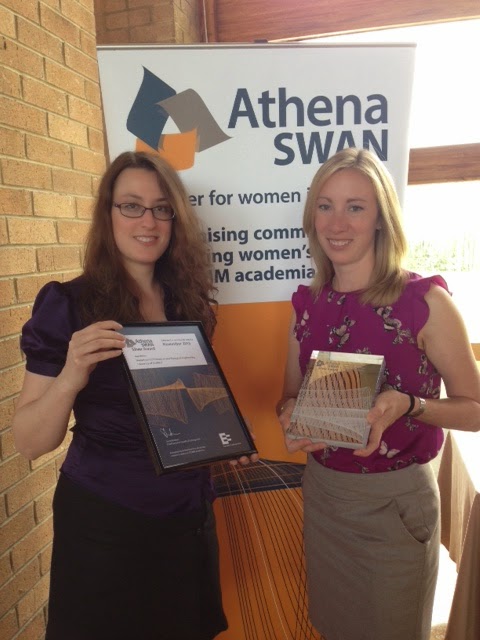
Ioanna Dimitriou and Rachael with the Certificate
and Trophy for the CBE Silver Athena SWAN Award.
Over the last few years I have become more involved in efforts to increase the number of women in engineering. I led CBE’s successful Athena SWAN Silver award submission and through this have been active in improving culture in the department. I’m looking forward to bringing my experience and skills to the faculty role. Four other departments in the faculty have bronze awards - It’s been exciting to see the changes that have gone on in the Faculty over the last few years, partly due to our Athena SWAN activities and partly due to increased awareness of some of the issues we face. We have made excellent progress, but still have some way to go. The primary goal is to make positive changes and improve working culture; not just getting awards, but making them count. It is great to see the efforts being made by all of the departments and very rewarding to see them recognised.

The remit of FDWiE includes equality and diversity, as well as gender – the most striking inequality in engineering. I have recently reviewed our structure and am pleased to say that we are introducing a Faculty Equality and Diversity Committee. I am recruiting members now and we hope to have the first meeting before the end of the year. 

Alongside my women in engineering activities, my research investigates carbon dioxide utilisation to form fuels and I am of course still running and orienteering, although there’s more coaching and less racing creeping in. To add another ball to my already full juggling arms, I am 20 weeks pregnant so embarking on yet more challenges and unknowns. :) But that’s the subject of a future blog post!

If you have any comment or would like to get in touch, please do! My email address is: r.elder@sheffield.ac.uk.

Rachael


Wednesday, 29 October 2014

#BustingStereotypes with Sebastiana.

On Tuesday 28th October the BBC ran a special day of events celebrating the achievements of inspirational women. You might have seen us joining in, by tweeting about our own University of Sheffield women who are #BustingStereotypes. Today we have a post about a young family who are also #BustingStereotypes in the way they've decided to divide up childcare - and what that means for their careers.

It's a well-known fact that studying for a PhD requires hard work, commitment, dedication and the drive to succeed. It's also a well-known fact that being a mother is difficult - sleepless nights, nappy changes and the challenges of parenting all take their toll. A lot has been written about the challenges of balancing an academic career and parenthood - but what about those who become parents while they're still studying?

Sebastiana, who studied Industrial Chemistry and Chemical Engineering undergraduate and masters degrees at the University of Catania (Sicily) before moving to Sheffield with her Italian husband earlier this year, is in the first year of her PhD in Synthetic Ecology - and also in her first year of bringing up a young daughter. We caught up with her in the Mappin Café to find out about the challenges of bringing up a family, overcoming stereotypes and why some of the same skills are needed in both engineering and parenting.

Sebastiana decided to become an engineer after being inspired by her husband and sisters, who both have engineering degrees. "In Italy, being an engineer is prestigious - it's a title, like 'Doctor', people might refer to you as Engineer. It means you have a good education and good skills. There is some dirty work, but fundamentally it's a top position." Having studied Chemistry, she realised that engineering has a more practical focus, working on solving real-world problems, and this is what attracted her. It wasn't an easy choice - in Italy only two out of twenty people studying her course were female, and she acknowledges that it was harder for her than others. "As a woman in science, I had to work to be better than everybody else - not only academically, but I had to work harder to prove myself, because I am a woman. Some of my professors had old-fashioned views about things."

Sebastiana was six months pregnant by the end of her Masters degree, and she knew she wanted to carry on with a PhD at Sheffield. Although her parents were extremely supportive of her career choices, that wasn't the case for everybody in her life. "In Sicily, where I come from, there is still this perception - why do you need to work? Your husband has a job! You're expected to stop working when you have a baby," she says. "But I was very clear with my husband from the start - this is what I want to do. He supports me in that."

So, in the last weeks of her pregnancy, she prepared and submitted her research proposal, choosing Sheffield because of its place in international university rankings and the research interests of her supervisor. Just one week after she gave birth to her daughter, she was interviewed - and offered a place. She and her family made the move to Sheffield earlier this year. Now, she spends her days in the lab, while her husband looks after their daughter. "I didn't want to put my career on hold because I had had a baby - I felt like I'd miss opportunities. My husband doesn't speak much English - when the baby is a little older he can go to English classes - so this was the best choice."

"In Sicily this would be really unusual. But studying for my PhD, that's my 'me time'!" she laughs.

How does she balance her responsibilities? "I come into work early, take just a 30 minute lunch break, and focus on what I have to do while I'm here. My husband looks after the baby in the day and when I'm home in the evening that's my time for my husband and my family - though I do sometimes work at the weekend, if the baby is asleep. The supervisor is important - PhD students can feel isolated because there's just you and the research. But my supervisor is really supportive. When I said I had a baby, he said "that's great!" He treats me just like he treats everybody else. In the future I want to move into a post-doctoral position and carry on researching."

Would Sebastiana encourage other women to follow a career in engineering? "I don't think we should distinguish between men and women," she says. "It should be about whether you have the skills and the capacity. But I think females can be better than males! Women don't fear challenges and problems and can deal with a lot of things - we are multi-taskers. You need all these skills as an engineer."

I ask how having a daughter has changed her. "I am more patient now. Things go wrong in parenting and you have to try to find solutions. The baby can't talk! But it's the same in the lab - things don't work as they should and you have to try to fix it. It's all research."

Would she want her daughter to be an engineer? "She might have different aspirations. Both her parents are engineers, so no pressure! I want her to know that she has options and can choose - she can be whatever she wants to be."


Finally, I ask Sebastiana whether having a baby and studying engineering means that she still has to be better than everybody else - do people doubt her commitment to her role? Does she still have to prove herself all the time? "I still work hard, but because I want to work hard and do well, because I want the University to be proud of me like I am of belonging to it...not because people doubt my value. But being both a mum and an engineer doesn't make me that unusual. When you are motivated and you have one true dream, you find inside you the strength to do what you want to do."

Tuesday, 21 October 2014

Sheffield academic nominated in the 2014 WISE Awards!

If you've been following us for a while, it will come as no surprise that the University of Sheffield's Faculty of Engineering has plenty of inspirational female role-models. So we're delighted that one of our own has been nominated in the 2014 WISE Awards! Professor Elena Rodriguez-Falcon, Professor of Enterprise and Engineering Education, Director of Enterprise Education in the University of Sheffield, Faculty Director of Communications and External Relations, and (last but certainly not least!) former Faculty Director for Women in Engineering, has been shortlisted for the 2014 WISE Champion Award.

WISE (or Women into Science, Engineering and Construction) works to inspire girls to choose science, technology, engineering and mathematics pathways and has the target of increasing the number of girls in the STEM workforce to 30% by 2020. The WISE Awards is an annual event which recognises and celebrates the achievements of individuals and organisations which are actively working towards WISE's goals. For her work in encouraging the recruitment, retention and progression of women in STEM subjects, Elena has been nominated as "an individual champion who has used their position to influence others to take positive action to promote female talent in STEM, within their own organisation or beyond." Elena was tasked with setting up the Women in Engineering project at Sheffield and led the initiative for three years.


The award ceremony will take place on Thursday 13 November at the Grange Hotel, Tower Bridge, London, and we'll keep you up to date with the winners. Congratulations, Elena!


Tuesday, 16 September 2014

One to Watch: Bioengineering student Shruti Vasudev makes her mark on her placement year.


Last year Shruti spoke to us about choosing Sheffield and her experiences so far at the University. A year on and she has made the most of the opportunities that have come her way by actively seeking out further career opportunities and training to add to her ever-growing knowledge and experience of engineering.

Being highly motivated and ambitious one of Shruti’s greatest achievements over this past year took place on her placement year with National Instruments (NI) where she led a team to victory working on a robotic arm draughts opponent.


Tell us about the team you successfully managed to victory:
Each year the Application Engineering (AE) department at NI divides itself into four teams to participate in the four-month long AE projects competition alongside our daily roles. Rather than sit back I nominated myself to become the project manager for one of the groups which saw me lead other interns as well as graduate experienced employees by creating an automated draughts opponent using LabVIEW and the new NI myRIO. We were announced as winners and treated to a lovely day out and gifted an NI branded polo shirt with 'AE project winners 2014' written on the back. 

The experience helped me realise my passion for management and I decided to enroll onto an external self-funded course called PRINCE2. This course is a project management course that many companies follow the principles of and I passed both the foundation and practitioner exams for the course and am now officially a PRINCE2 Practitioner. NI have offered me a graduate job to be taken up upon the completion of my degree after seeing my work and enthusiasm over the year.

How did it feel managing a group of engineers?
Part of my group was made up of interns who started with me and had similar levels of technical knowledge and experience as me so it was easier than I thought. The experienced engineers are great at what they do and with them I took the approach of learning from their individual management styles and experiences. I would ask them for their opinions on how a task should be done and then use the advice that made most sense to me and matched my project plans. When I nominated myself for the role I knew this was my one chance to learn about project management from the experienced team members on this team who had had previous experience at managing teams and were willing to teach me as we went along .

You said you nominated yourself - do you feel pressure to 'step forward' and be seen because of your gender or are you a natural leader?
No, I did not feel pressured at all. I do agree that there are fewer women than men in the engineering industry but that is changing and if you work hard and prove yourself to be worthy of a role then people will respect you irrespective of your gender. I feel I am a natural leader who thrives in management related roles and am constantly trying to improve and further develop my leadership skills by learning from the people around me. 

Every team in the project had a mentor and I took a lot of guidance from our mentor for my project manager role. My mentor helped me develop my management style and advised me on different approaches to managing the different people in the team and I learned a great deal as a result of this.

What’s been the biggest learning curve?
Very early on in this internship I realised that I am here not to prove myself or the skills I already possess but to try and acquire new skills and knowledge from the pool of brilliant, talented and experienced engineers I was working with. This attitude and willingness to learn is what I feel, has benefited me most during this placement year. It has enabled me to have no inhibitions when working with more experienced people in the department and ask them to teach me something they are good at. 


What else are you working on at National Instruments at the moment?
I joined NI as an Applications Engineer, where after my intense training of two months, I began supporting our customers. NI has about 35,000 companies as customers around the world in different sectors of engineering and my role as Applications Engineer is to support these customers using our products. I have to understand their engineering applications which could range from medical to aerospace to radio frequency related. Many at times I need to recreate their problems in our lab using the same products and then try and find a technical solution for them.

I was also given the opportunity to do a three month stint/rotation in the technical sales department as a technical sales engineer. These three months really opened my eyes to the business side of engineering and gave me a different perspective of the industry. My role was primarily understanding the application needs of our customers and supporting them by advising on the right software and hardware products to satisfy their needs. Many at times I had to match their specifications with our products and produce a product list and quote for them. I was mainly in-charge of business in Scotland and North East of England and worked with a Field Engineer based in the area to support our business in the area.

Tell us more about the rowing event you organised as part of the NI team:
This was a fun event. Every year the Newbury Round table organises a massive charity event called Crafty Craft which involves building your own boat, forming a team and taking part in a boat race in the canal in Newbury. This year I was in-charge of organising our team. I began working on oganising teams to work on this event with me and I got some very talented people to fix our boat, paint it and also got some great rowers from the company. The theme for Crafty Craft this year was 'Brazilian Adventure'  and we named our team 'myRIO Car-NI-val' – a pun on the latest NI product myRIO and NI for National Instruments.

Tuesday, 9 September 2014

Hard Work, Luck and a Great Mentor = the Perfect Recipe for Success

Annette Baxter from the Careers Service explains the difference a good mentor can make. She draws on the examples of elite athletes, and the support teams that guide them towards their success, illustrating the importance of developing a network for achieving your goals. Annette also highlights mentoring schemes engineering students can access.


Ask most successful people what it was that helped them to achieve success in their careers, and many will mention a lot of hard work, some will say a modicum of luck but most will also refer to the help and support they received from a significant person who pointed them in the right direction or gave them the time, encouragement and support to achieve their goals. Some would call this inspirational person a friend, a parent, a teacher or a manager but the common term in industry is often a mentor.

A mentor can share the benefits of their experience and insights in industry, a company or job role; they can give you advice and tips on the recruitment process and help you face job search and progression with greater confidence. They may also help you to assess your current skills, identify gaps in your skill or knowledge base and then help you to identify strategies for meeting these development needs.

"Remember the old phrase ‘it’s not just what you know, but who you know’ that can make the difference."

No one can ever tell you what to do, but people often say that discussing a situation with another objective person can help them to see different perspectives, generate other ideas, find alternative ways of overcoming obstacles or handling situations and therefore make better decisions – benefiting from the experience (and mistakes) of someone else who may have been in that situation before.

Whatever you want to achieve, your role as mentee is to define the goals you want to achieve and a mentor may be able to help you to identify the steps you need to take to achieve them, offering feedback and encouragement along the way.

When you look at any successful athlete or sportsperson like Andy Murray or our very own Jessica Ennis, they are surrounded by a team of people to help them reach peak performance and achieve the accolade in their event. They may have a coach, nutritionist, physiotherapist just to name a few and just as in sports, you may want to build a team around you to improve your career fitness and support you to achieve success in your career.


In the careers sense ‘your team’ may include an academic or project supervisor, a Careers Adviser, family members but it can also include a career mentor (or all of them), each able to offer you advice and support to help you achieve your career goals.

You don’t have to wait until you get into employment to have a mentor, you can start to build your network now by contacting the Careers Service and speaking to a careers adviser. You may want to join the Email Mentoring Scheme offered by the Careers Service, and mentoring schemes are also offered by professional bodies such as the Institution of Engineering and Technology (IET) who offer mentoring to engineering students.

If you want to widen your professional network wider, professional bodies such as Institution of Mechanical Engineers (IMechE) or Royal Aeronautical Society (RAeS) also have opportunities for students to meet with society members and build their professional network. Social media sites such as LinkedIn can also be invaluable to help you develop your professional networks but who knows, this may be the topic of a future blog on this site!

Remember the old phrase ‘it’s not just what you know, but who you know’ that can make the difference. Start today by building your network and finding your mentor for success.